A powerful new lens on an ancient truth.
Why GRP is the Real Secret to Success, Happiness, and a Better World.
Buy on Amazon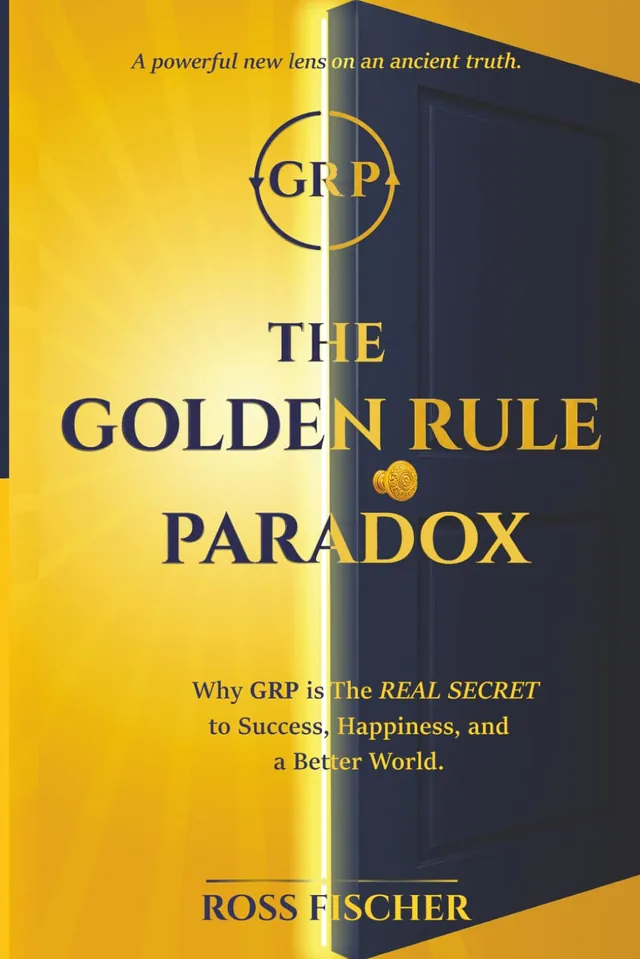
Every major spiritual tradition for three millennia has agreed on a single rule: treat others the way you wish to be treated. We teach it to children. We file it under "common sense." We rarely live by it.
What no one has done — until now — is treat the Golden Rule as a measurable, physical law and assemble the science to prove it. GRP The Golden Rule Paradox is the result of nine years of research across neuroscience, epidemiology, behavioral economics, primatology, and history. The thesis is simple, but the evidence is overwhelming: the more we prioritize others' needs above our own, the more fulfilled, healthier, and longer-lived we become.
Conversely, the more we prioritize our own desires over the needs of others, or at the expense of others, the less happy, healthy and successful we will be.
This is the opposite of what we are taught daily in our current society, which is: to be happy, you need X (money, house, car, or whatever someone wants to sell you).
All those things are great, but that's not what makes you happy. What truly makes us truly happy is what we do for other people.
Those with eudaimonic well-being showed favorable gene-expression profiles in their immune cells — and those with hedonic well-being showed an adverse gene-expression profile. Neither group could tell the difference in their own health. Same feeling, different biology. The body knew what the mind couldn't see. Those individuals who were happier because of selfless reasons had healthier gene markers than those that were happier because of selfish or materialistic reasons!
In the moment, as everyone around him celebrated wildly, Aaron Rodgers said to himself: "Wow, is that all there is?" After just accomplishing the goal that he has wanted from childhood, he wondered why he wasn't happier. When we focus on ourselves, when we are chasing a feeling… even absolute success does not bring inner peace.
Kennedy Littledyle lost her leg in a car accident at 16. "I'm in a whole different, harder situation, but I'm so much happier," she said. "I would go through this accident. I would go through the pain, I would go through it all again, just to have that rewarding feeling, and feeling like I made a difference in someone's life. So I love it. I really do. And it makes me feel like I make a difference in this world."
Le Chambon, France, 1944. Some people ask Magda Trocmé, "How did you make a decision?" There was no decision to make. The issue was: do you think we are all brothers, or not? Magda Trocmé and her village would go on to save 5,000 lives. They did not look at themselves as being heroes — just something that they were "supposed to do."
Short, straight-talking videos on why giving is the real secret to success.
Nine years of research. Nine chapters. One idea that could change everything.
Available in paperback and Kindle on Amazon.
Also available on Kindle.
