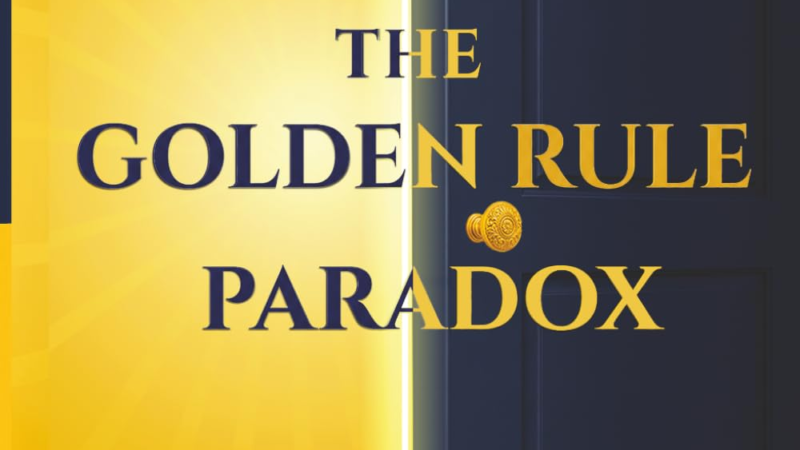
One Simple Idea That Could Save Your Marriage

What if one of the most powerful things you could do to improve your marriage was also one of the simplest?
Stop asking, “What am I getting?”
Start asking, “What can I give?”
It sounds almost too simple. But that simple shift captures one of the central ideas behind GRP—The Golden Rule Paradox: Thinking of others first ultimately benefits you more.
And there may be no place where that paradox becomes more obvious—or more important—than in marriage.
The Trap Almost Every Marriage Faces
Most marriages don’t begin selfishly.
Two people fall in love. They want to make each other happy. They do thoughtful things without being asked. They compromise. They forgive. They listen. They make sacrifices, because seeing the other person happy makes them happy.
Then life happens.
Careers. Children. Bills. Responsibilities. Stress. Exhaustion.
And somewhere along the way, the questions can begin to change.
Why am I always the one who does this?
Why doesn’t my spouse appreciate me?
What about what I need?
Why should I do that… when they don’t do this for me?
Without even realizing it, a relationship that began with two people trying to give to each other can slowly become two people keeping score.
And that’s where the trouble begins.
The Golden Rule Paradox of Marriage
GRP begins with a remarkably simple premise:
Thinking of others first benefits you the most.
With GRP, Its opposite is equally important:
Prioritizing yourself at the expense of others ultimately comes at a cost to you.
Apply those two ideas to a marriage and something fascinating happens.
Imagine a marriage in which both people wake up primarily concerned with getting their own needs met. Each person waits for the other to change. Each notices what the other isn’t doing. Every sacrifice becomes something to remember, and every disappointment becomes another entry on an invisible scoreboard.
Eventually, both people can feel as though they are losing.
Now reverse it.
Imagine a marriage in which both people genuinely care about making life better for the other.
Each listens because the other’s feelings matter. Each looks for opportunities to help. Each expresses appreciation. Each is willing to compromise. Each wants the other person to feel loved, respected, supported, and valued.
Who benefits?
Both of them.
That’s GRP.
By focusing less exclusively on your own happiness, you help create the kind of relationship that is far more likely to make you happy.
Marriage Is Not a Transaction
One of the most destructive things that can happen in a relationship is for love to become transactional.
I’ll do this if you do that.
I’ll be affectionate when you’re more attentive.
I’ll help when you start helping.
I’ll apologize when you apologize.
The relationship becomes a negotiation between two competing interests.
GRP offers a completely different lens.
Your spouse’s happiness and your happiness are not necessarily opposing interests.
They are interconnected.
When you make your spouse feel appreciated, you are strengthening your marriage.
When you listen instead of immediately defending yourself, you are strengthening your marriage.
When you do something thoughtful without calculating what you will receive in return, you are strengthening your marriage.
And because you live inside that marriage too, you are ultimately creating a better environment for yourself.
In terms of GRP, helping your spouse and helping yourself are not mutually exclusive.
Very often, they are the same thing.
Remember, GRP works in Both Directions
This is where GRP goes beyond simply telling people to “be nice” to their spouse.
The paradox has another side.
Self-focus can become self-defeating.
The more someone obsesses over whether every interaction is fair to them, whether their needs are being sufficiently recognized, or whether they are getting as much as they are giving, the easier it becomes to notice every slight and overlook every act of kindness.
Resentment creates distance.
Distance creates less affection, less communication, and less generosity.
That creates more resentment.
Eventually, the attempt to protect your own happiness can help destroy the very relationship that was supposed to provide so much of it.
GRP turns that equation around.
Generosity can create gratitude.
Gratitude can create affection.
Affection can create connection.
Connection can make generosity easier.
One cycle pulls two people apart.
The other pulls them together.
GRP Does Not Mean Becoming a Doormat
Thinking of your spouse first does not mean accepting abuse, tolerating betrayal, abandoning boundaries, or allowing another person to continually take advantage of you.
That isn’t a healthy marriage, and it isn’t GRP.
GRP works precisely because genuine concern for others and genuine long-term self-interest so often point in the same direction.
A healthy marriage requires two people who recognize that the well-being of the person sitting across from them matters.
Sometimes that means sacrificing.
Sometimes it means compromising.
Sometimes it means forgiving.
And sometimes caring about the future of both people means drawing a boundary or confronting a serious problem rather than ignoring it.
The principle isn’t “Give your spouse everything they want.”
It is much bigger than that:
Make their well-being genuinely important to you.
Try One Simple Question
For the next week, try something.
Instead of beginning each day by unconsciously evaluating what your spouse is or isn’t doing for you, ask:
“What can I do today to make my spouse’s life a little better?”
It doesn’t have to be dramatic.
Make the coffee.
Send the text.
Handle something they normally have to handle.
Listen for five minutes without looking at your phone.
Say thank you for something you’ve stopped noticing.
Give the compliment you’ve been thinking but haven’t said.
Ask how their day went—and actually care about the answer.
None of these things alone will save a troubled marriage.
But the principle behind them just might.
Because imagine what happens when one person begins living this way.
Then imagine what happens when both do.
The more each person thinks about the other, the better the marriage becomes for both.
What makes GRP a paradox?
We live in a culture that constantly tells us to pursue our own happiness.
Know what you want.
Protect your interests.
Put yourself first.
Make sure your needs are being met.
But GRP reveals the paradox hidden inside that message: the relentless pursuit of our own happiness can sometimes take us further away from it.
Marriage gives us an opportunity to choose another path.
Think of the other person.
Care about what they need.
Give without constantly keeping score.
Make their happiness part of your happiness.
Because perhaps the best way to create the marriage you want isn’t to spend your life asking your spouse to give you more.
It is to become the kind of spouse who gives more yourself.
And when two people understand that simple idea, something remarkable happens:
Neither person has to put themselves first—because they have someone else doing it for them.
That is GRP.
And it may be one of the simplest ideas that can save a marriage.

Ross Fischer
Author · GRP
Nine years assembling the evidence behind the book — across neuroscience, epidemiology, behavioral economics, history and the natural world. He writes as a teacher and a father rather than an academic.
Read the whole argument
One idea, followed from your marriage all the way to the 2008 financial crisis.
Get the book on Amazon Request the press kit