What the heck is GRP?

If you’ve found your way here, there’s a pretty good chance you’re wondering exactly that.
What the heck is GRP?
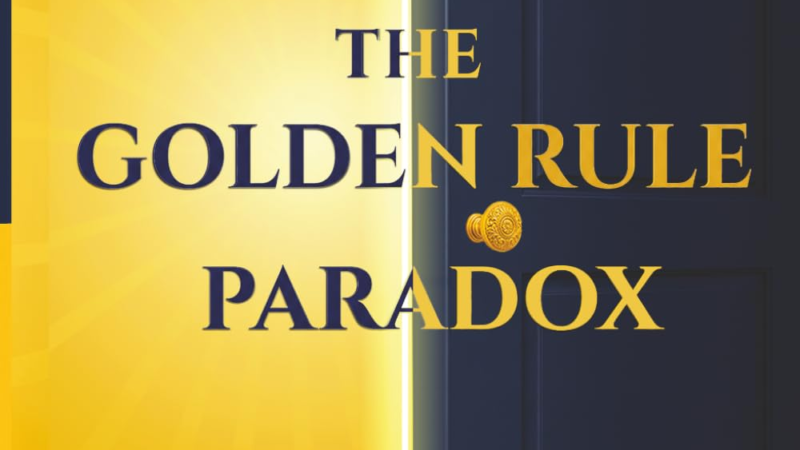
GRP stands for The Golden Rule Paradox.
And it begins with an idea you’ve probably known since childhood:
Treat others the way you want to be treated. Nothing new there.
But what if we’ve been looking at the Golden Rule backwards?
What if treating others well isn’t only good for them?
What if it’s actually one of the best things you can do for yourself?
That’s where GRP starts.
GRP Works Both Ways
At the heart of The Golden Rule Paradox are two simple ideas:
The more you think of others’ needs before your own desires, the more you enrich yourself with real, lasting happiness.
The more you prioritize your own desires over the needs of others, the less fulfilled you ultimately become.
In other words:
Helping others helps you.
And:
Selfishness ultimately hurts you.
That sounds almost too simple. Until you start looking for it.
Because once you do, GRP is everywhere.
And We Mean Everywhere
It’s in our happiness.
It’s in our physical and mental health.
It’s in our marriages, friendships, families, and relationships.
It’s in the way we work, lead, compete, and build businesses.
It’s in our pursuit of money, status, possessions, and success.
It’s in social media, politics, healthcare, education, and financial institutions.
It’s even in the story of how human beings survived and evolved in the first place.
Again and again, the same pattern appears:
When people connect, cooperate, help, give, and genuinely care about one another, they are the one that benefits the most.
And when self-interest becomes so dominant that the needs of everyone else become secondary, the selfish person is the one that suffers the most.
That’s GRP.
But Is There Actually Science Behind This?
That’s where things get really interesting. The book takes what started as a good idea, and proves beyond any shadow of doubt… that GRP is real.
GRP: The Golden Rule Paradox follows this idea through research in psychology, medicine, neuroscience, sociology, and other fields—through nearly 30 major studies, including research on happiness, longevity, loneliness, altruism, addiction, neuroscience, relationships, wealth, and human behavior; as well as broader meta-analyses encompassing hundreds of individual studies. But the evidence isn’t found only in laboratories. The book brings GRP to life through real people and their stories: pivotal moments throughout human history, and the words of remarkable leaders, thinkers, and humanitarians across generations. From Albert Einstein and Ralph Waldo Emerson, to Jane Goodall, Martin Luther King Jr., and many others. Study after study, story after story, and generation after generation, the same pattern keeps appearing: Both sides of GRP are everywhere.
The deeper you go, the harder GRP becomes to unsee.
GRP Isn’t Telling You Not to Succeed
This is important.
GRP isn’t anti-success. It isn’t anti-money. It isn’t anti-business or anti-capitalism. And it certainly doesn’t mean allowing people to walk all over you.
You can be ambitious. Compete. Become wealthy. Build a company. Set boundaries. Try to be the absolute best at what you do.
The question is how you do it.
Can you win without unnecessarily making someone else lose?
Can a business make tremendous profits while genuinely caring about its customers and employees?
Can pursuing someone else’s success actually increase your own?
The research and stories behind those questions are another major part of The Golden Rule Paradox.
A Self-Help Book… and a World-Help Book
GRP begins with one person:
What happens to me when I start thinking more about you?
But it eventually leads to a much bigger question:
What happens when an entire society does the same thing?
What if we applied the same principle to our families, workplaces, corporations, healthcare systems, schools, financial institutions, social-media companies, and governments?
What if considering the needs of others wasn’t simply something we taught children… but something we actually built into the way our institutions operate?
And that’s where GRP goes from a paradox… to a paradigm that can change the world!
And that’s why this isn’t simply a self-help book. It’s also a world-help book.
Because GRP makes a surprisingly big claim from an incredibly simple idea:
Thinking of others first makes us happier, healthier, more successful, and more fulfilled.
Thinking only of ourselves ultimately makes our lives—and our world—worse.
The evidence is all around us. You just have to know where to look.
And once you start seeing GRP… you will start seeing it everywhere.
GRP Always Has Two Sides
But what happens when “me first” becomes not just an occasional instinct, but a way of life?
Relationships weaken. Connection disappears. Enough never feels like enough.
And then take that same mindset and multiply it by millions of people.
Put enormous financial, technological, or political power behind it.
Now GRP isn’t just about one person’s happiness. It’s about the kind of world we’re creating.
When companies pursue profit without adequately considering customers or employees…
When social-media platforms prioritize engagement while ignoring the damage their products may be causing…
When political success depends more on defeating the other side than working with them…
This sounds a lot like the world we live in today.
Different problems begin to reveal the same underlying pattern:
What I want matters more than what happens to you.
And eventually, what happens to you comes back around to affect me.
GRP Can Change This!
That’s what GRP is… and that’s why we say with confidence that GRP is the real secret to happiness, success, and a better world.

Ross Fischer
Author · GRP
Nine years assembling the evidence behind the book — across neuroscience, epidemiology, behavioral economics, history and the natural world. He writes as a teacher and a father rather than an academic.
Read the whole argument
One idea, followed from your marriage all the way to the 2008 financial crisis.
Get the book on Amazon Request the press kit